



RML2future Press releases

Network is creating a competence centre – successful start conference in Eupen

Download Pdf

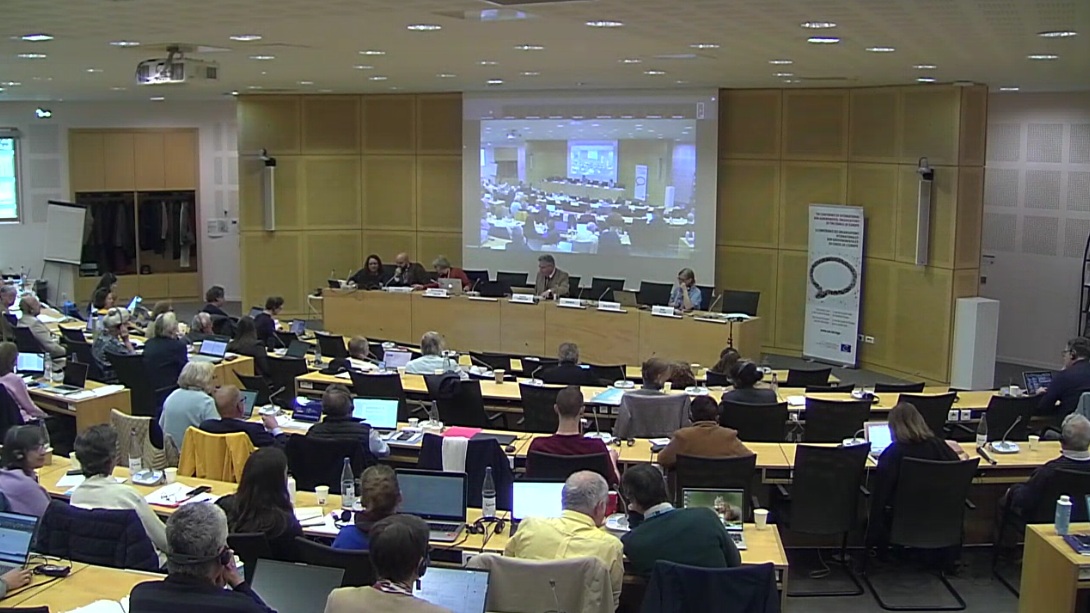
About 60 participants from different regions of Europe met each other in Eupen, Belgium, during the last days. They attended the regional conference of the network “RML2future – Network for Multilingualism and Linguistic Diversity in Europe. It was the first conference of the network, which under the aegis of FUEN (Federal Union of European Nationalities) set as its aim to promote multilingualism and linguistic diversity in Europe, while focusing in particular on the regional and minority languages.

“We met in Eupen in order to work on one of our main topics, namely language certification and assessment of language skills”, project manager Judith Walde explains. She outlines the additional main reasons behind the successful start conference and the basic ideas behind the network “RML2future”. “We have three years to establish a competence centre for the regional and minority languages. For that reason we need a strong, motivated network from the different regions of Europe, and this is what we wanted to get of the ground in Eupen.”

The conference was attended by representatives from Lusatia, the German-Danish border region and from North Frisia in Germany, from South Tyrol in Italy, from Carinthia and Burgenland in Austria, from West Frisia in the Netherlands and the German-speaking Community in Belgium.

“We had a very good, positive conference. We succeeded in bringing professionals and academics together. Our objective is mainly that the network and later also the competence centre will produce benefits in a practical sense for the regional and minority languages in Europe”, said Edgar Hungs, leader of the European Education Agency of the German-speaking Community and representative in the network “RML2future”, about the objectives of the network.

The German-speaking Community (DG) Belgium is rightly – as the participants could see for theirselves – a good example in the field of language certification in a small language community. Education Minister Oliver Paasch of the German-speaking Community – who is also patron for the focus area of education within FUEN – explained “knowledge-based education policy as guiding principle for political action”, which has to be based on empirical data. And therefore in Eupen many experiences have been made in the field of language certification and the development of applicable methodologies is ongoing.

The guests – amongst them were teachers, kindergarten-teachers, representatives from education authorities, scholars – had the opportunity to get more information in workshops on the European Language Passport, on procedures for language assessment and on the transfer of language in general.

Johan Häggman, who still is member of cabinet of the outgoing EU-Commissioner for Multilingualism Leonard Orban, gave a speech on multilingualism policy in the European Union. The major importance of multilingualism is according to Häggman a clearly stated objective in the EU and of great significance, not in the last place in the field of economic competitiveness in times of globalisation. Often less understood is that also the regional and minority languages – beyond their cultural relevance – are of interest to the EU.

“We are proud of our network RML2future”, said Hans Heinrich Hansen, president of FUEN. “Apart from just working on the matter while establishing the competence centre, we want to collect the needs and wishes from the professionals on which we can base our political action. Exchange with people from practice is needed in order to help them politically.

The result of the meeting was that such assignments of both professional and political nature were defined. Amongst other things ideas for the establishment of a European minority teachers association, the translation of the Language Passport in regional and minority languages and for regional exchange and cooperation and concrete instructions for the establishment of the competence centre were defined.

“It will be our task within the network RML2future now to collect the good ideas and to coordinate the initiatives, so that our network is strengthened and we can work targeted on the idea of a competence centre”, said Judith Walde, summing up the results of the conference.

The next conference will take place at Højskolen Østersøen in the German-Danish border region in the end of 2010.

Contact

Edgar Hungs:
edgar.hungs@aebp.be
0032 (0) 87596384
0032 (0) 473137782

Judith Walde:
judith.walde@fuen.org
0049 (0) 173 9936731

More information about the network at:

www.rml2future.eu/news/index_de
www.dglive.be/agentur/

Eupen, 4th February 2010

Information about the network RML2future

The network RML2future is dedicated to the promotion of multilingualism and linguistic diversity in Europe, actively involving regional and minority languages (RML).

The main aim of the network is to promote the Europe objective of multilingualism, namely that each European citizen learns his own mother language and two additional languages. The network does so by using the European regional and minority languages and trying to exploit this resource of natural bilingualism and multilingualism. The potential of multilingual regions should be used in order to reach the European objective and in regard to the value of multilingualism and its positive effect for the preservation of linguistic diversity.

In order to use the regional potential for education the network, in cooperation between practitioners, experts and decision makers, wants to create language-friendly environments in the regions, including the minority languages. It does so by building up know-how in the field of language planning and language policy amongst those people who are involved.

For this on a regular basis expert conferences are organised within the three years duration of the network, which is supported by the European Union.

The network is supported by European Commission
and the Autonomous Region Trentino-South Tyrol.
This project is funded with support from the European Commission. This publication reflects the views only of the author, and the Commission cannot be held responsible for any use which may be made of the information contained therein.